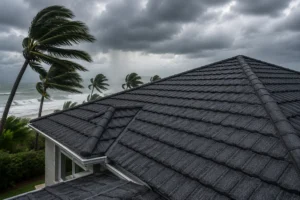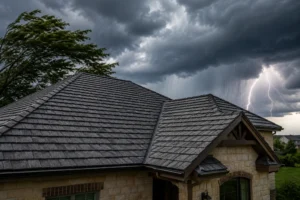
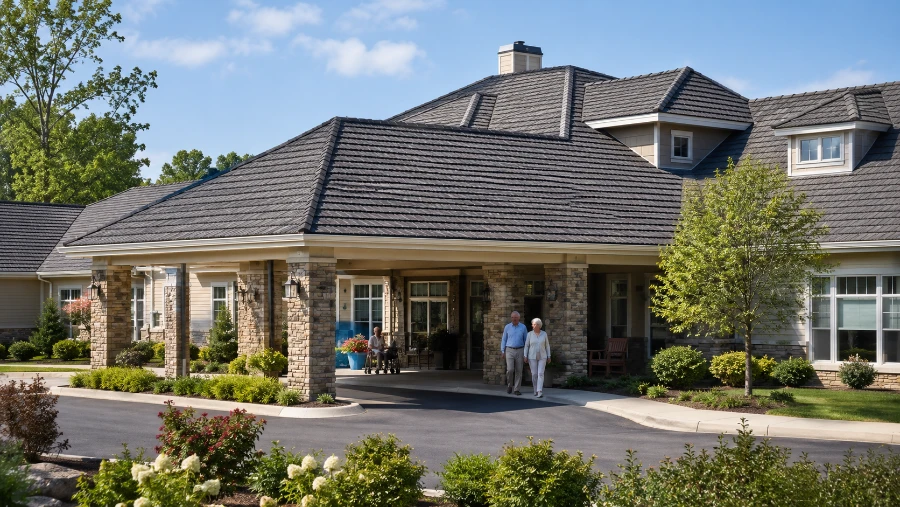
Choosing the right assisted living roofing systems is about far more than keeping rain out of a building. The roof protects residents who may have limited mobility, safeguards mechanical equipment, supports comfortable indoor temperatures, and helps facility managers control long-term operating costs. That is a lot of responsibility for one building component! A poor roofing decision can lead to leaks, resident disruption, rising utility bills, repeated repairs, and temporary room closures.
Assisted living facilities also operate differently from offices, warehouses, and retail buildings. Residents live there around the clock. Meals are served on schedule. Medication routines cannot be interrupted. Emergency access must remain open.
Roofing work must respect all of that.
This guide explains how facility owners, property managers, developers, and maintenance teams can compare roofing materials, plan replacement projects, control disruption, and make decisions based on long-term value rather than the lowest initial bid.
What Makes Assisted Living Roofing Different?
A roof replacement at an assisted living community is rarely a simple construction project. It takes place above an occupied residential environment where comfort, safety, and predictability matter every day.
Several factors make these properties unique.
Residents Remain Inside During Most Projects
Unlike a vacant commercial building, an assisted living facility usually cannot close while roofing work is underway. Contractors must work around residents, staff members, visitors, deliveries, emergency services, and scheduled activities.
That changes how the project should be planned.
Noise must be controlled. Walkways must stay protected. Debris cannot be allowed near entrances, gardens, patios, or transportation areas. Contractors also need clear rules regarding where crews may park, store materials, and access the roof.
Vulnerable Residents Require Extra Protection
Some residents may use wheelchairs, walkers, oxygen equipment, or hearing aids. Others may become confused or distressed by unusual construction noise.
A dropped tool, blocked sidewalk, or unsecured work zone creates more risk at an assisted living property than it might at a typical commercial site.
Facility managers should require a written resident-protection plan before work begins. The plan should identify safe entrances, temporary walkways, delivery routes, emergency access points, work hours, and procedures for reporting problems.
Roof Designs Are Often Complex
Many senior living campuses combine several roof types. A property may have steep residential-style wings, flat sections over kitchens, covered walkways, mechanical equipment areas, and low-slope additions.
One material may not work everywhere.
The best assisted living roofing systems often combine pitched roofing and commercial low-slope membranes, with carefully designed transitions between the two.
Key Priorities When Choosing a Roofing System
There is no single roofing material that suits every facility. The right choice depends on the building design, local weather, existing structure, available budget, and expected ownership period.
Still, several priorities should guide almost every decision.
Durability
Roof replacement is disruptive and expensive. A system that lasts longer can reduce the number of major construction projects residents experience during the life of the building.
Durability should include more than estimated service life. Ask how the material performs during hail, high winds, heavy rain, extreme heat, freeze-thaw cycles, and repeated foot traffic.
Low Maintenance
Every roof needs attention, but some systems require more frequent repairs than others.
A low-maintenance system reduces emergency calls, interior damage, and unplanned spending. It also makes budgeting easier for owners who manage multiple facilities.
Fire Performance
Fire resistance is especially important in buildings occupied by residents who may need assistance evacuating.
Roofing material, underlayment, insulation, decking, and installation methods all affect the complete assembly’s fire performance. Facility owners should verify applicable product ratings and local building requirements rather than relying on broad marketing claims.
Energy Efficiency
A roof can influence indoor temperatures and heating and cooling costs. Reflective surfaces, proper ventilation, insulation, and air sealing can all improve performance.
This matters because assisted living facilities operate continuously. Even modest energy improvements can create meaningful savings over time.
Installation Disruption
A durable roof is valuable, but the installation process must also be manageable.
Consider noise, odors, vibration, equipment placement, temporary closures, and project duration. Some materials require hot-applied products or heavy equipment, while others can be installed with fewer disruptions.
Appearance
Assisted living communities often aim to feel residential rather than institutional. Roofing plays a major role in that appearance.
Materials that resemble shingles, tile, or wood shakes may complement the architecture better than visibly industrial systems, especially on pitched roofs facing streets, courtyards, and resident areas.
Common Assisted Living Roofing Systems
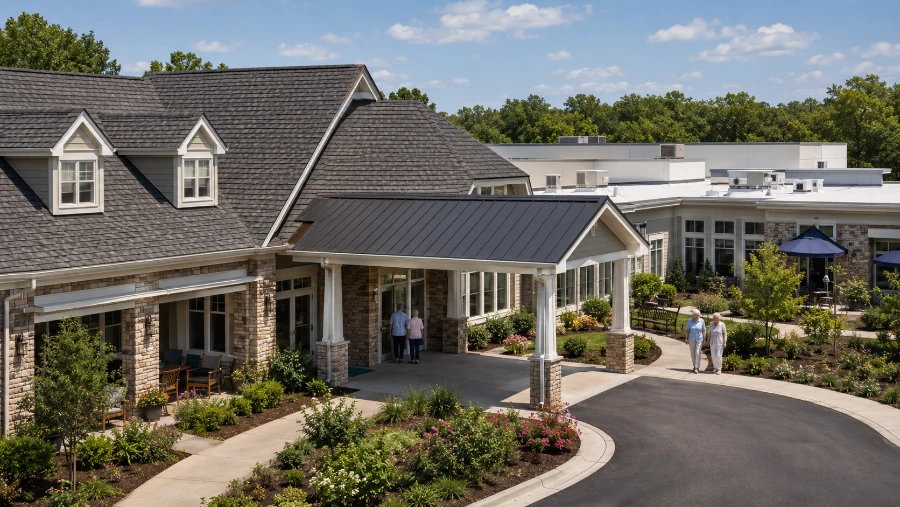
Several roofing materials are commonly used on senior living properties. Each has strengths, limitations, and ideal applications.
Asphalt Shingles
Asphalt shingles remain common on pitched assisted living buildings because they are familiar, widely available, and relatively affordable.
They can work well on smaller facilities, residential-style wings, cottages, and low-rise communities. Repairs are usually straightforward, and many contractors have experience installing them.
However, asphalt shingles may require replacement sooner than metal systems and can also be vulnerable to hail, high winds, heat, and granule loss as they age.
They may be a practical choice when:
- The project has a limited initial budget
- The roof has a simple, steep-slope design
- Matching nearby residential architecture is important
- The owner expects to sell or renovate within a shorter period
They may be less suitable when the goal is maximum service life or minimal future replacement activity.
Standing Seam Metal Roofing
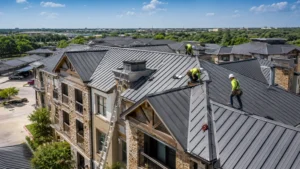
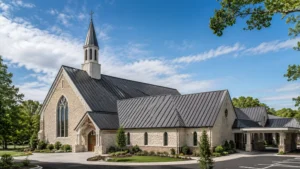
Standing seam metal roofing uses long metal panels with raised seams. It is durable, weather-resistant, and often chosen for pitched or low-slope applications.
The concealed fasteners help reduce potential leak points. Metal panels can also shed rain and snow efficiently.
Still, proper installation is critical. Poorly designed flashing, incorrect movement allowances, or weak transitions can lead to problems.
Standing seam metal may cost more upfront than asphalt shingles. It can also produce noticeable sound during installation and may look more commercial than residential, depending on the building design.
Stone-Coated Steel Roofing
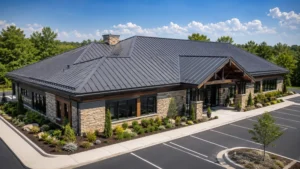
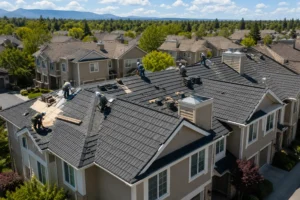
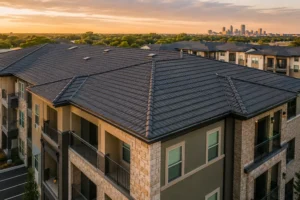
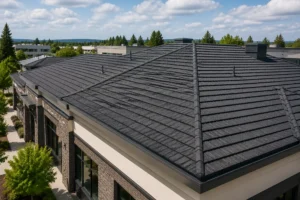
Stone-coated steel combines the strength of metal with the appearance of traditional shingles, shakes, or tile. That balance makes it one of the most attractive assisted living roofing systems for pitched senior living buildings.
The steel core provides structural strength, while the stone coating creates texture and a residential appearance. The finished roof can complement cottages, memory care facilities, clubhouses, and large multiwing communities.
Key advantages include:
- Strong resistance to wind and impact
- Lightweight construction
- Long expected service life
- Lower maintenance requirements
- Residential-style appearance
- Fire-resistant assembly options
- Better resistance to cracking than some tile products
Its lighter weight can also be useful when owners want a tile-style appearance without placing the same load on the roof structure.
Installation quality matters. Panels, battens, fasteners, flashing, underlayment, and ventilation must all work as one system. Facility owners should choose contractors who have direct experience with the product rather than assuming any metal roofer can install it correctly.
TPO Roofing
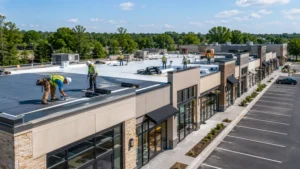
Thermoplastic polyolefin, commonly called TPO, is often used on flat and low-slope sections. It is a single-ply membrane with heat-welded seams.
TPO is popular because its light-colored surface can reflect sunlight and reduce heat absorption. It is commonly used over kitchens, corridors, administrative wings, and mechanical areas.
Benefits include:
- Reflective surface options
- Welded seams
- Relatively lightweight installation
- Suitability for large low-slope roofs
- Broad commercial availability
Potential weaknesses include punctures, poorly welded seams, drainage issues, and damage around rooftop equipment.
Regular inspections are important, especially where maintenance crews frequently walk.
EPDM Roofing
EPDM is a rubber roofing membrane commonly installed on flat or low-slope buildings. It has been used for decades and performs well in many climates.
Its flexibility allows it to expand and contract as temperatures change. It can also be repaired with compatible materials when damage occurs.
Traditional EPDM is usually dark, which may absorb more heat than reflective membranes. White versions and coatings may be available, but owners should compare complete system costs and performance.
EPDM may be a good option for large roof areas with relatively simple layouts.
Modified Bitumen Roofing
Modified bitumen roofing combines asphalt with reinforcing materials. It is often installed in multiple layers, providing added protection against punctures and foot traffic.
That can be useful on assisted living roofs containing HVAC units, exhaust systems, kitchen equipment, or other components requiring regular service.
Installation methods vary. Some systems are self-adhered, while others use heat, adhesives, or mechanical fastening. Because odors and open-flame work may create concerns around residents, facility managers should review the proposed installation method carefully.
Built-Up Roofing
Built-up roofing uses alternating layers of asphalt and reinforcement, often finished with gravel or a protective surface.
It can provide strong waterproofing and impact resistance. However, the system may be heavy, and installation can involve odors, hot materials, and longer project timelines.
Built-up roofing may still be appropriate for some existing commercial buildings, but many occupied senior living facilities choose systems with less disruptive installation methods.
Comparing Roofing Options
The following table provides a practical starting point.
| Roofing system | Best application | Maintenance level | Weather resistance | Relative initial cost | General service-life range |
| Asphalt shingles | Pitched residential-style roofs | Moderate | Moderate | Low to moderate | 15–30 years |
| Standing seam metal | Pitched and some low-slope roofs | Low | High | High | 40–60 years |
| Stone-coated steel | Pitched roofs | Low | High | Moderate to high | 40–70 years |
| TPO | Flat and low-slope roofs | Moderate | Moderate to high | Moderate | 20–30 years |
| EPDM | Flat and low-slope roofs | Moderate | Moderate | Moderate | 20–30 years |
| Modified bitumen | Low-slope roofs with foot traffic | Moderate | High | Moderate | 20–30 years |
| Built-up roofing | Large commercial low-slope roofs | Moderate | High | Moderate to high | 20–40 years |
These ranges are general estimates, not guarantees. Actual performance depends on climate, product quality, installation, ventilation, drainage, maintenance, and roof traffic.
Why Stone-Coated Steel Fits Many Senior Living Communities
Stone-coated steel deserves special consideration because it addresses several challenges at once.
It provides strength without the extreme weight of traditional clay or concrete tile. It can withstand demanding weather more effectively than many standard shingles and it also maintains a welcoming, residential appearance.
That matters.
Residents and families often prefer communities that feel like home. A roof that resembles dimensional shingles, tile, or shake can support that atmosphere without sacrificing durability.
Owners evaluating this option can review the broader applications, benefits, and ownership considerations of commercial stone-coated roofing before selecting it for pitched facility buildings.
Stone-coated steel may also reduce the likelihood of another full roof replacement in the near future. For facility owners, that can mean fewer disruptions, lower disposal costs, and more predictable capital planning.
However, it is not automatically the best choice for every building. Flat roof areas still require a compatible low-slope system. The project team must also verify structural conditions, ventilation, flashing details, and local code requirements.
The strongest assisted living roofing systems are selected building by building, not material by material.
Energy Efficiency and Resident Comfort
Indoor comfort matters every day in senior living.
Older adults may be more sensitive to temperature changes, and assisted living buildings often contain many individual rooms, shared dining areas, kitchens, laundry spaces, and activity rooms. Cooling and heating loads can be substantial.
Roofing improvements should be coordinated with:
- Insulation levels
- Attic ventilation
- Air sealing
- Reflective surfaces
- HVAC performance
- Solar exposure
- Window and wall efficiency
A reflective roof can help reduce heat absorption, but it cannot compensate for wet insulation or major air leaks. The roof assembly’s thermal conductivity also affects how readily heat passes through its materials, making insulation selection and installation quality important parts of the facility’s energy strategy.
Before replacing the roof, ask the contractor or building consultant to evaluate the insulation condition. If moisture is trapped below the existing system, covering it may preserve the problem rather than solve it.
Facility owners comparing reflective materials can also review the U.S. Department of Energy’s guidance on energy-efficient cool roof products. This resource can help project teams evaluate reflectance, thermal performance, and life-cycle cost rather than judging products by color alone.
Facility owners should also review attic temperatures, ventilation paths, and penetrations. Correcting these issues during roof replacement is usually easier and less expensive than returning later.
Fire Safety Considerations
Fire performance should be evaluated as a complete roof assembly.
The visible roofing material is only one component. Underlayment, decking, insulation, fasteners, ventilation, and nearby combustible materials all affect risk.
Owners should confirm:
- The tested fire classification of the complete assembly
- Whether local codes require a specific rating
- How penetrations will be sealed
- Whether rooftop equipment creates additional hazards
- How work will affect existing fire alarms or suppression systems
- Whether hot-work permits are required
During construction, emergency lanes must remain open. Fire department connections, hydrants, exits, and evacuation paths cannot be blocked by dumpsters, delivery trucks, lifts, or stored materials.
This requirement should be written into the project plan.
Weather Resistance and Regional Climate
Roof selection should reflect actual regional risks.
A roof in Texas may face high heat, hail, severe thunderstorms, and strong winds. A coastal facility may also need enhanced corrosion resistance. Northern properties must account for snow loads, ice, and freeze-thaw movement.
Ask specific questions rather than accepting vague claims.
What is the system’s tested wind rating? How does it perform under impact? What fasteners are required? Are edge details included in the tested assembly? Can replacement panels or matching materials be sourced later?
The perimeter deserves special attention. Roof failures often begin at edges, corners, transitions, and penetrations, where wind pressure can be strongest.
For pitched assisted living roofing systems, contractors should inspect valleys, ridges, wall intersections, chimneys, vents, skylights, and covered walkway connections. On flat roofs, they should inspect drains, scuppers, seams, curbs, and expansion joints.
Roof Drainage and Moisture Management
Water must leave the roof quickly and predictably.
Ponding water can accelerate membrane deterioration, strain drainage systems, and expose weak seams. Clogged gutters can direct water toward walls, foundations, entrances, and resident walkways.
A roof replacement plan should address:
- Gutter capacity
- Downspout placement
- Internal drains
- Scuppers
- Overflow drainage
- Roof slope
- Crickets behind equipment
- Flashing height
- Drain access for maintenance
Do not replace the roof while ignoring poor drainage. The new material may fail for the same reason the old one did.
Facility teams should also create a simple leak-reporting procedure. Staff members who notice ceiling stains, peeling paint, musty odors, or damp flooring should know exactly whom to contact.
Fast reporting limits damage.
Planning an Assisted Living Roof Replacement
A well-run project begins long before materials arrive.
Start With a Thorough Inspection
The inspection should document surface condition, moisture, insulation, decking, flashing, drainage, ventilation, rooftop equipment, and interior signs of leakage.
Core samples or moisture scans may be appropriate for low-slope systems. Pitched roofs may require attic inspection and deck evaluation.
Compare Repair and Replacement Honestly
Repeated repairs can look less expensive because each invoice is smaller. Over several years, however, the total may exceed the cost of replacement while residents continue dealing with leaks.
Review repair history, roof age, moisture damage, energy performance, warranty status, and future renovation plans.
Build a Realistic Budget
The budget should include more than roofing material.
Account for:
- Deck replacement
- Wet insulation removal
- Flashing
- Drainage improvements
- Equipment relocation
- Permit costs
- Safety barriers
- Temporary protection
- Landscaping repairs
- Contingency funds
A contingency allowance may be sensible when the roof’s underlying condition is uncertain. The exact amount should reflect the inspection results and the risk of concealed damage.
Plan the Work in Phases
Phasing reduces the number of residents affected at one time. It also allows the facility to protect entrances, dining areas, memory care units, and high-traffic zones.
Work zones should be clearly mapped and shared with staff before each phase begins.
Minimizing Disruption During Roofing Work
Resident comfort should be treated as a project requirement, not a courtesy.
Construction teams should coordinate noisy work around meals, rest periods, therapy sessions, and scheduled events. The facility may need to relocate activities temporarily.
Useful controls include:
- Starting later near sleeping areas
- Avoiding loud work during medication rounds
- Using quieter equipment where practical
- Keeping dumpsters away from resident windows
- Scheduling deliveries outside peak visitor hours
- Providing daily progress updates
- Assigning one contact person for staff concerns
Odor control also matters. Adhesives, coatings, and hot-applied products can affect indoor air quality. Air intakes may need temporary protection or controlled shutdown under professional supervision.
Never improvise around ventilation equipment. Coordinate with facility engineers and HVAC contractors.
Safety Requirements During Installation
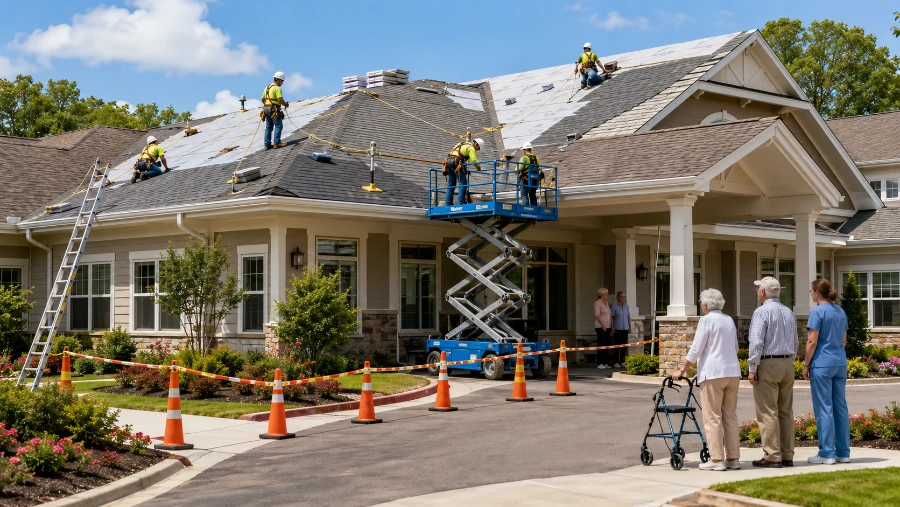
Every contractor should submit a site-specific safety plan.
The plan should cover fall protection, ladders, scaffolding, lifts, debris control, material storage, pedestrian routes, emergency access, and weather shutdown procedures.
Daily cleanup is essential.
Loose fasteners, packaging, sharp metal scraps, and roofing granules can create slip, trip, and puncture hazards. Magnetic sweeps may help collect metal debris around parking areas and sidewalks.
Contractors should also secure tools and materials at the end of each shift. High winds can turn unsecured items into dangerous projectiles.
Repair or Replace?
The answer depends on condition, not age alone.
A younger roof may need replacement if installation defects or trapped moisture are widespread. An older roof may remain serviceable if it has been maintained well and damage is limited.
Replacement becomes more likely when:
- Leaks appear in several areas
- Repairs fail repeatedly
- Insulation is wet
- Decking has deteriorated
- Materials are brittle or unavailable
- Energy performance is poor
- The roof is near the end of its expected life
- The facility plans a major renovation
Repair may make sense when damage is isolated, the system remains stable, and compatible materials are available.
Document the decision. Future managers will benefit from knowing why the facility repaired or replaced the roof.
Maintenance Tips for Assisted Living Roofing Systems
Maintenance does not need to be complicated, but it must be consistent.
Schedule professional inspections at least once or twice each year and after major storms. Internal maintenance teams should also watch for warning signs between inspections.
A useful maintenance checklist includes:
- Clear gutters and drains
- Remove branches and debris
- Inspect flashing and sealants
- Check rooftop equipment curbs
- Look for loose panels or membrane damage
- Review ceiling stains
- Confirm drainage after heavy rain
- Restrict unnecessary roof traffic
- Keep repair records and photographs
Facilities using stone-coated steel can follow a more detailed stone-coated roof maintenance checklist to organize drainage cleaning, flashing checks, storm assessments, inspections, and repair documentation.
Avoid allowing untrained vendors to cut or drill through the roof. Every new pipe, cable, vent, or equipment mount creates a potential leak point.
Require roofing contractor approval before penetrations are added.
Budgeting Based on Life-Cycle Cost
The cheapest roof is not always the least expensive roof.
Facility owners should compare total ownership costs, including installation, repairs, energy use, maintenance, insurance implications, disruption, and future replacement.
For example, asphalt shingles may cost less initially than stone-coated steel. However, if the shingles require replacement sooner, the owner may pay for labor, disposal, resident protection, landscaping repairs, and project management more than once.
Longer-lasting assisted living roofing systems may produce better value even when the first invoice is higher.
Create a 20-, 30-, or 40-year cost comparison. That time frame aligns better with real estate planning than a simple bid comparison.
Choosing the Right Roofing Contractor
Experience matters, especially on occupied senior living properties.
Ask each contractor for examples of similar projects. A crew experienced with warehouses may not understand the communication, access, and resident-protection standards required in assisted living.
Review:
- Licensing and insurance
- Commercial roofing experience
- Manufacturer training
- Safety record
- Project supervision
- Resident-protection plans
- Cleanup procedures
- Warranty coverage
- Emergency response policies
- References from occupied facilities
The proposal should clearly state what is included and excluded. It should also identify who is responsible for permits, temporary protection, damaged decking, drainage corrections, and final inspections.
Vague proposals create expensive arguments later.
Questions to Ask Before Approving the Project
Before signing a contract, ask:
- Which roofing system best fits each roof section?
- How will residents and visitors be protected?
- What work will create the most noise?
- How will odors and dust be controlled?
- Will emergency entrances stay open?
- What happens if rain begins during installation?
- How will unexpected deck damage be priced?
- Who will communicate daily progress?
- What maintenance will the warranty require?
- Who handles repairs after the project is finished?
Clear answers build confidence. Evasive answers signal risk.
Final Thoughts
Choosing among assisted living roofing systems requires more than comparing material prices. The roof must protect residents, support uninterrupted operations, control energy use, resist local weather, and remain manageable for maintenance teams.
Asphalt shingles, standing seam metal, stone-coated steel, TPO, EPDM, modified bitumen, and built-up roofing can all serve a purpose. The right solution may combine several of them.
For pitched buildings, stone-coated steel offers an appealing balance of durability, weather resistance, light weight, and residential appearance. For flat sections, a carefully designed membrane system may be more appropriate.
Look beyond the initial cost. Review the building as a complete system. Plan around the people who live and work inside it.
That is how a roofing project becomes a long-term asset rather than another recurring problem.
FAQs
Common options include stone-coated steel, metal, asphalt shingles, TPO, EPDM, and modified bitumen.
Yes. It offers strong durability, weather resistance, and a residential appearance.
Lifespans vary, but many systems last 20–70 years depending on the material and maintenance.
Usually, yes. Proper phasing, safety barriers, and clear communication help reduce disruption.
They can control noise, protect walkways, schedule carefully, and provide daily updates.
TPO, EPDM, modified bitumen, and built-up roofing are common choices.
Inspect it once or twice a year and after major storms.
Repair isolated damage, but consider replacement for recurring leaks or widespread deterioration.
Reflective materials, insulation, and ventilation can help lower heating and cooling costs.
Choose a licensed, insured contractor with commercial and occupied-facility experience.